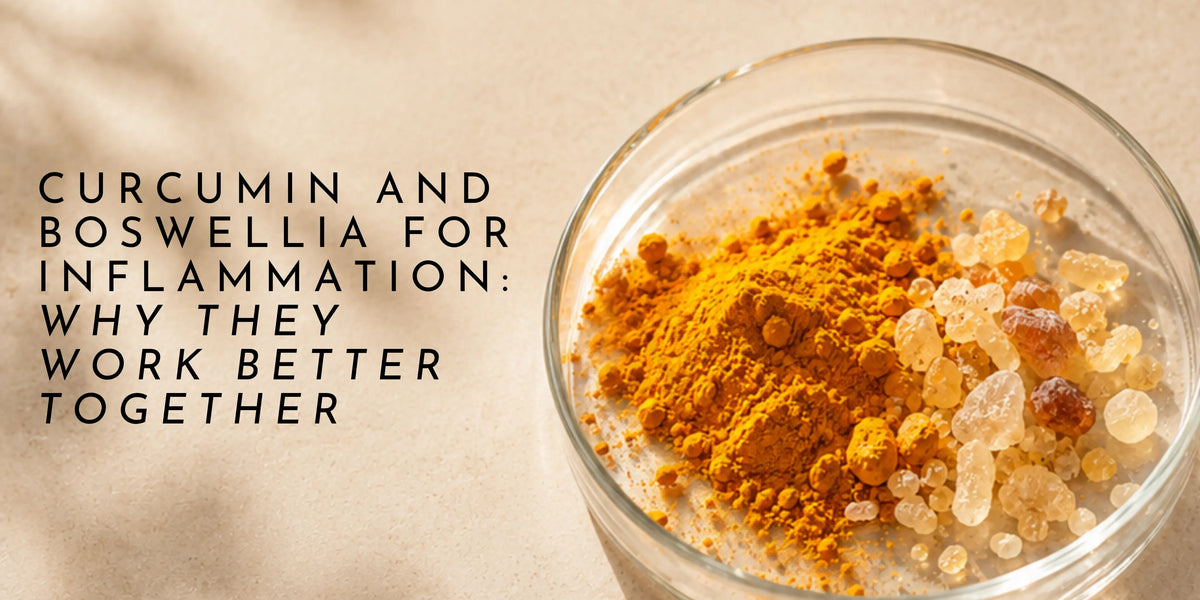
Curcumin and Boswellia for Inflammation: Why They Work Better Together
1 day ago
·
1 day ago
·
If you've spent any time looking at supplements for inflammation, joint health or recovery, chances are you've come across curcumin. You may be slightly less familiar with boswellia, although it increasingly appears alongside curcumin in formulations designed to support inflammation and joint comfort.
At first glance, putting the two together seems fairly straightforward. Both are plant-derived bioactives, both have a long history of traditional use, and both have been studied for their effects on inflammatory processes. But scientifically, this combination is interesting not simply because you're getting two anti-inflammatory ingredients instead of one.
It's because they don't appear to work in the same way.
Inflammation is often described as a single process that can simply be turned up or down. In reality, it involves a large network of enzymes, signalling molecules, immune cells and biological pathways, all communicating with one another. This is part of what makes inflammation so important to normal health, but also why persistent inflammatory signalling can affect everything from joint comfort and recovery to the way our bodies age.
That's also why combining bioactives that interact with different parts of this network can be particularly interesting.
Curcumin does more than give turmeric its colour
Curcumin is one of the major bioactive compounds found in turmeric. Although turmeric has been used traditionally for centuries, curcumin has become a major focus of modern research.
Much of that research has centred on its relationship with inflammation and oxidative stress. Curcumin has been shown to interact with several signalling pathways involved in the inflammatory response, including NF-κB, as well as enzymes and signalling molecules such as COX-2 and inflammatory cytokines.
That doesn't mean curcumin simply “stops inflammation”, nor would we want it to. Inflammation is an essential part of the body's defence and repair system. We rely on it when we fight an infection, recover from exercise or heal an injury. The more useful conversation is around what happens when inflammatory signalling becomes persistent, particularly as we get older.
This is where curcumin becomes relevant beyond the usual turmeric-for-sore-joints conversation. Chronic, low-grade inflammation is increasingly studied as a biological process associated with ageing, often described in research as inflammageing. At the same time, oxidative stress can influence many of the same cellular pathways, creating considerable overlap between the two processes.
Curcumin's ability to interact with both inflammatory and oxidative pathways is one reason it continues to attract so much scientific attention.
But it isn't the only plant bioactive worth looking at.
Boswellia approaches inflammation differently
Boswellia serrata is a tree native to parts of India, North Africa and the Middle East. Its resin contains compounds known as boswellic acids, which researchers have studied for their effects on inflammatory processes, particularly related to joint comfort and mobility.
What makes boswellia interesting alongside curcumin is that the two don't simply appear to be doing the same job.
Boswellic acids have been investigated for their influence on 5-lipoxygenase, or 5-LOX, an enzyme involved in forming inflammatory compounds called leukotrienes. Curcumin, meanwhile, has been studied across a broader collection of signalling pathways and inflammatory mediators.
Some overlap exists, as you would expect in something as interconnected as inflammation, but their mechanisms aren't identical. Rather than thinking about curcumin and boswellia as two versions of the same ingredient, it makes more sense to think about them as two plant bioactives approaching the same biological problem from different directions.
That distinction is important, because biology rarely gives us one pathway to target.
This is where the idea of synergy becomes interesting
We often approach supplements by asking which individual ingredient is “best”. What's the best ingredient for inflammation? What's the best antioxidant? What's the best supplement for healthy ageing?
It's understandable, particularly when most products are marketed around a hero ingredient, but the human body doesn't operate in isolated categories. Inflammation interacts with oxidative stress. Oxidative stress affects cellular function. Stress hormones influence inflammatory signalling. Sleep, exercise, diet, age and metabolic health can influence all of them.
This is one reason we are interested in the concept of synergy at STMNA Bioactives.
The goal isn't to keep adding ingredients until a supplement label looks impressive. It's to understand what each bioactive does, where its mechanisms overlap with another, and, importantly, where they differ. A thoughtfully formulated combination can potentially provide broader biological support than simply increasing the amount of one compound.
Curcumin and boswellia illustrate this particularly well. Both have evidence supporting their role in inflammatory health, but their differing mechanisms mean the combination can interact with more than one part of the inflammatory response. Clinical research has also begun investigating curcumin and boswellia together, particularly for joint discomfort and physical function, adding another layer of interest to a pairing that already makes sense mechanistically.
However, there is an important catch when we talk about curcumin.
Curcumin has an absorption problem
Curcumin may be well researched, but it has relatively poor bioavailability when consumed on its own. It isn't easily absorbed through the gastrointestinal tract and, once absorbed, the body metabolises and eliminates it relatively quickly.
This matters because the amount of an ingredient listed on a supplement label doesn't necessarily reflect how much the body can actually use.
One of the best-known ways of addressing this is piperine, the primary bioactive compound found in black pepper. Research shows that piperine can substantially increase curcumin bioavailability by influencing the processes involved in its metabolism and elimination.
This is why you will often see black pepper extract sitting quietly beside curcumin in a well-considered formulation. It may not be the ingredient that gets the attention, but it serves a very specific purpose.
For us, this is another good example of why formulation matters just as much as the individual ingredients themselves. Curcumin brings one set of biological actions, boswellia contributes another, and black pepper helps address one of curcumin's most significant practical limitations.
It isn't about squeezing another ingredient onto the label. It's about understanding why it needs to be there.
Looking beyond the single-ingredient approach
The more we learn about inflammation, oxidative stress and ageing, the harder it becomes to view any of them as isolated processes. The pathways involved overlap constantly, which is why we don't believe supporting healthy ageing should revolve around finding one “super ingredient”.
When we developed Healthspan, we included curcumin and boswellia as part of a broader six-extract formulation rather than as an isolated inflammation blend. We included black pepper extract alongside curcumin to support its bioavailability. Then, we selected other plant bioactives for their roles in oxidative stress, cellular protection, stress resilience, and other pathways relevant to long-term health.
That is ultimately what makes the curcumin and boswellia pairing interesting to us. Not because either ingredient is a magic solution for inflammation, but because together they show a bigger principle in plant bioactive science: when different compounds influence different biological pathways, how you combine them can matter as much as which ingredients you choose.
And when you start looking at supplements through that lens, the ingredient list becomes a lot more interesting.
The thinking behind Healthspan
Healthspan combines curcumin, boswellia and black pepper with three additional researched plant extracts, creating a multi-pathway approach to supporting inflammation, recovery and healthy ageing.
Because when inflammation involves more than one biological pathway, it makes sense to support more than one.
Discover how Healthspan supports inflammation click here